
 Live Radio
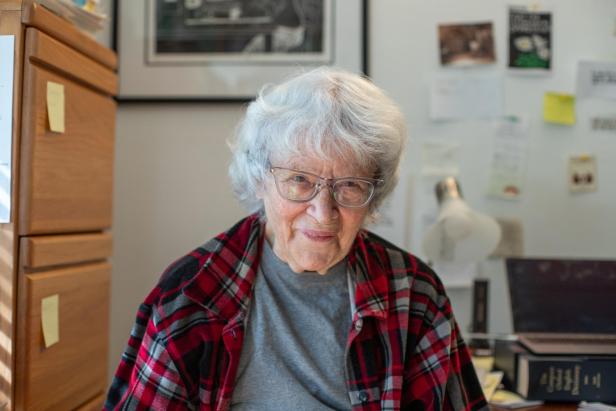 photo credit: Chelsea Kurnick
JJ Wilson taught some of the first Women's Studies classes at SSU.
It’s been a little more than a year since Sonoma State University announced some drastic cuts to address its budget deficit. While a few of the cuts have since been restored, the Women’s and Gender Studies program is still slated to close. Sonoma State was one the first universities in the nation to offer such classes.
J.J. Wilson, an English professor at Sonoma State, says her life changed at a Modern Language Association meeting in 1970 when she heard Florence Howe and other fiery feminists speak about women in literature.
She remembers being in a crowd of women packed into a stuffy basement room inside a Hilton Hotel in New York City, then floating out the door afterward, realizing what her life's work would be.
“They lighted a flame inside, not only me, but many other people I know,” Wilson says. “We came back to our own campuses and I joined a group of women students who were beginning to have a consciousness raising group. They were wonderful and taught me so much.”
Wilson and the students planned the school's first women's studies class, a student-taught seminar on Women and History offered in Spring 1971. Wilson taught a Women and Literature course that summer. She says faculty and administrators at the college were supportive of the burgeoning field of study, even though they often missed the mark.
Wilson says, “One of the teachers came to me in the summer so excited and said, ‘You'll be so glad, J.J. – we've added Madame Bovary!’ Of course, it's by a male writer and she ends with a suicide. But aside from that, I was supposed to look real happy. It took a while for the faculty to reeducate themselves.”
As women students developed more and more classes at Sonoma State, they also fought to make the campus more supportive of their lives. Wilson said men would bring their dogs to school, and that after some people were bit, the campus installed kennels people could check their dogs into during class. For a time, Sonoma State had dog daycare, but not childcare.
“So what we did is take our babies – I didn't have any, but people who had children – and put signs on 'em saying, ‘We'll bite you if you don't give us a place,’” Wilson shares. “And the next day we had a trailer next to our women's studies trailer, which was a childcare, and we've had childcare ever since.”
Wilson also remembers women creating a pop-up do-it-yourself divorce clinic in Stevenson Hall to spare people the cost of hiring a lawyer. She remembers women standing in long lines that surrounded the building.
“The line extended around Stevenson, around Stevenson–” Wilson says.
Demand was so high that campus administrators got fed up.
“They sort of said, ‘I think you'll have to meet off campus.’ Because it was cluttering up the scenery!” Wilson says.
Wilson, now 89 years old, still lives in Sonoma County. Her home doubles as a feminist space called the Sitting Room Library. In the garage, she keeps much of the ephemera from the early days of women's studies at Sonoma State.
A flyer from Spring 1976 lists almost 40 different classes, most taught by student instructors. Topics include "Survival as a Mother," "Seminar on Rape," "Lesbian Relationships," "Women and Weight," and even a radio production class called "Women on the Air."
Wilson says, “Sonoma State had been a seed farm and we used that as our metaphor. That's what we claimed we were still doing, is planting seeds.”
Before it became a state college, the original site of Sonoma State was an onion farm nestled in the rolling hills of Sonoma County. Throughout the 1960s and into the 70s, the school had a reputation for being radical – a stark contrast to the more conservative, agricultural community that surrounded it.
“It felt like education, it did all right. I learned more from the students than they learned from me, I'm sure,” Wilson says.
Over time, the seeds Wilson and the students planted blossomed into a department with four full-time faculty. In addition to Women’s and Gender Studies, they also offer a Queer Studies minor.
While Wilson feels optimistic that the lessons of women's and gender studies now pervade every other department on campus current professor Charlene Tung says women's and gender studies is still a critical field in its own right.
Tung explains, “It's the study of how gender as a construct, you know, is implicated in all of our power structures in our society. So, socially, legally, politically–and how it intersects, you know, centrally intersects with other social constructs like race and class, ethnicity, disability, gender identity, sexuality. It's about, you know, social justice and creating better futures for people. And that isn't done in every academic department.”
Editor's Note: This is part 1 in a two-part series; we'll air and publish part 2 tomorrow.

 NPR
NPR Spotify